
LED Lights Destroy Health
It's A Full Spectrum Assault

Virtually everyone in the Untied States is well aware of the recent nearly total elimination of incandescent lighting and its replacement by LED lighting.
The government claim for this draconian move, is that LED lights are more energy efficient than incandescent lights and that their length of service is much longer.
Both of these claims are true, but the ultimate result of this operation is, and will continue to be, less health for the users of LED lighting.
What Are LED Lights
An LED or light-emitting diode is an electronic component that uses a semiconductor to emit light when current flows through it. The color of the light (corresponding to the energy of the photons) is determined by the energy required for electrons to travel through the semiconductor. White light is obtained by using multiple semiconductors or a layer of light-emitting phosphor on the semiconductor device.
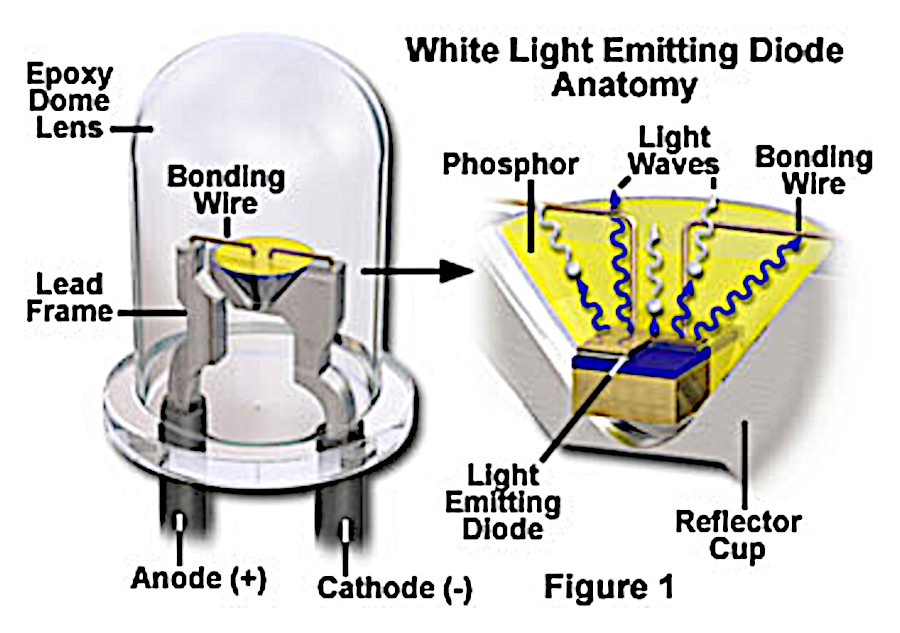
LED lights can produce infrared, visible or UV (ultraviolet) light. This occurs due to the selection of different semiconductor materials, so that single-color LED’s can be made that emit light in a narrow band of wavelengths, from the near-infrared through the visible spectrum and into the ultraviolet range.
Blue Light Causes Chronic Disease
Light is a component of the electromagnetic spectrum.
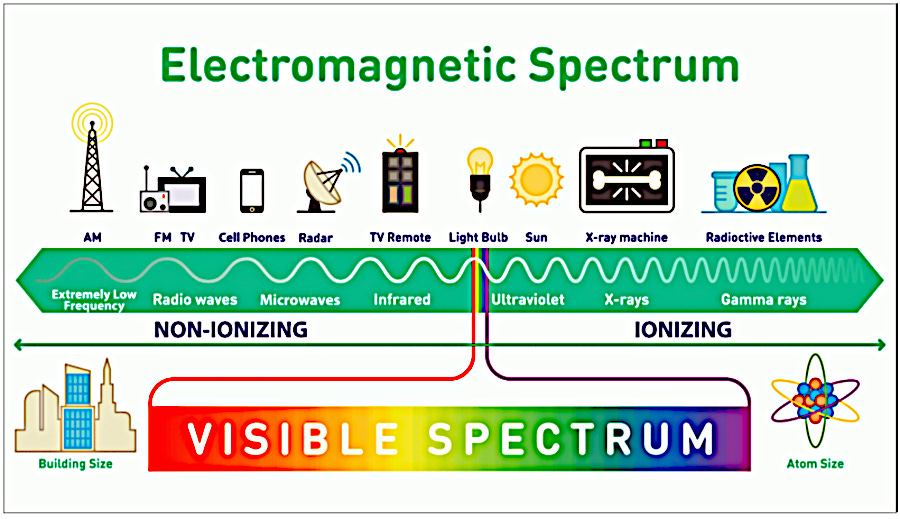
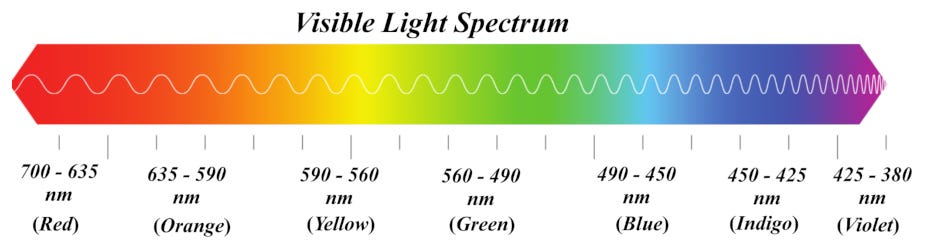
There are many types of light, some visible and some invisible. There are many types of light in full-spectrum Sunlight, such as Blue, Red, and UV. Different wavelengths of light impact our tissues at different levels, even at different depths.
A major component of white LED light is blue light.
Blue light negatively affects the vision of everyone whose sight comes in contact with it regardless of their distance from it’s source. Minimal high-intensity blue light from LED reflects on surfaces like desks and tabletops, which can bounce back up to the human eye even if you don’t look directly into the light. And from what we know, LED contains more blue light intensity than many other lighting sources like incandescent lighting and fluorescent lighting.
Exposure to constant blue light has been known to cause permanent damage to the retina. This damage occurs due to constant exposure or regular prolonged viewing of bright light.
In the elderly, this negative effect of vision caused by blue light is called “Age-Related Macula Degeneration” ,AMD, which accounts for roughly 35% of progressive blindness in people aged 75 and above.
Excessive blue light is a huge risk factor for chronic diseases. Over the past several decades, the number of hours the average person spends with their eyes locked on a blue screen has risen dramatically.
First it was TV. Many folks had the TV on all day till late at night. Then came personal video games that captured kids’ attention for hours. Computers, too, started carving out larger and larger slices of our day. Then laptops arrived that you could take anywhere. Then came the smartphones. Tablets. Devices that you could easily fit in a pocket or bag and take out whenever you had a free moment.
Now many people spend up to 90% of their time on a blue screen. As a result the average American today suffers from Excessive Blue Light Exposure (EBLE), likely without even knowing it.
Bright blue light works by stimulating cells in the retina that connect to the hypothalamus, a part of the brain that helps control circadian rhythms and many metabolic/endocrine functions.
Blue light exposure can affect dopamine and other hormones and can even cause psychological problems. The hormone melatonin controls our mitochondrial energy production. When Blue light overexposure disrupts melatonin production, we breathe less, sleep less, and suffer poor metabolism.
Aside from concerns about eye damage, too much blue light exposure at night is now linked with disruptions in circadian rhythms, and as mentioned above, this may be a risk for chronic diseases
Blood sugar fluctuations
Obesity/weight gain (due to changes in levels of leptin, a hormone that contributes to fullness)
Diabetes
Cardiovascular problems
Depression
Cancer
Headaches & Migraines
Any time you’re in front of blue light or staring at a computer monitor, you have no protection on your eyes or thyroid gland. You are potentially creating adrenal fatigue and hypothyroidism.
Blue light penetrates all the way into the fat layer where the arterials are carrying the oxygenated blood. To protect from this, folks need to cover up so the blue light effect can’t penetrate all the way into their body.
Dirty Electricity
Dirty electricity is created when altered currents of electricity get trapped inside electrical lines because the devices using that power are manipulating the way that it was originally designed.
The process of changing the electricity interrupts the normally smooth flow and creates instead, spikes and surges of electricity. These spikes and surges are often referred to as “dirty electricity” or “electrical noise.” These spikes and surges can adversely affect the operation of devices that are sensitive to them.
LEDs often produce this dirty electricity, adding it to the house electrical circuit. This is because LEDs often contain a device that changes mains AC electrical power in house wiring to DC, since DC power is what LEDs need to function correctly. The device that creates this conversion is called an internal switching regulator. This is used to limit the voltage entering the LED bulb, it operates on a much lower voltage than other household electronics.
Like all electronic devices, LEDs also emit some level of EMF radiation. This is mainly in the form of radio waves, which can interfere with the reception and performance of various electronic devices.
This radiation can also have damaging effects on the health of individuals exposed to it.
The frequencies found in dirty electricity can cause the following:
Headaches
Sleep issues, including falling and staying asleep
Mood swings
Arrhythmia
Fatigue
Disturbances in brain function
Tinnitus
Weaker immune system
Many of these are linked to the production of a hormone in your body called melatonin. Melatonin is the hormone that controls sleep patterns, and by extension mood and energy levels, all of which can be caused by negatively affected by exposure to EMF radiation.
LED Street Lights
Cities throughout the U.S. , Canada and Europe have been converting to LED street lighting to achieve savings and ostensibly reduce carbon emissions without taking account the resulting adverse health and ecological effects.
These lights are much more powerful and blinding than than the lights they replace, with many people complaining of various negative effects.
The American Medical Association came out with community guidance in 2016 to reduce the harmful human and environmental effects of high intensity street lighting. High-intensity LED lighting from street lights is designed to emit a large amount of blue light that appears white to the naked eye and creates a worse nighttime glare than conventional lighting.
Just as has been found with the recent LED house lighting conversion, "Despite the energy efficiency benefits, some (all) LED lights are harmful when used as street lighting," AMA Board Member Maya A. Babu, M.D., M.B.A. "The new AMA guidance encourages proper attention to optimal design and engineering features when converting to LED lighting that minimizes detrimental health and environmental effects."
High-intensity LED lighting creates worse nighttime glare than conventional lighting. Discomfort and disability from intense, blue-rich LED lighting can decrease visual acuity and safety, resulting in concerns and creating a road hazard.
Nighttime drivers have also noted the disturbing visual effect of LED car headlights, to the extent that some will no longer drive at night.
In addition to its impact on drivers, blue-rich LED streetlights operate at a wavelength that most adversely suppresses melatonin during night. It is estimated that white LED lamps have a five times greater impact on circadian sleep rhythms than conventional street lamps. Recent large surveys found that brighter residential nighttime lighting is associated with reduced sleep times, dissatisfaction with sleep quality, excessive sleepiness, impaired daytime functioning, and obesity.
Detrimental effects of high-intensity LED lighting not limited to humans.
Excessive outdoor lighting disrupts many species that need a dark environment. For instance, poorly designed LED lighting disorients some bird, insect, turtle, and fish species,
Worldwide Incandescent Light Ban
Make no mistake here. This mandate for LED light to replace incandescent light is a planned attack on humanity in general and just one aspect of the full spectrum assault that is specifically targeting the White Race.
Below is a world map showing where incandescent lights have been banned worldwide. …
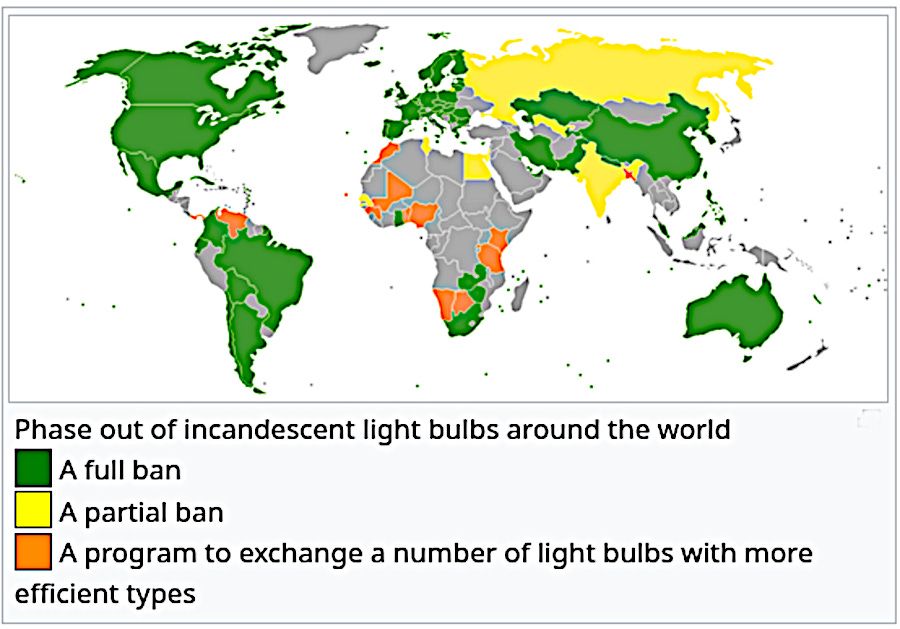
This ban is still in progress, so if you’re living in a country without a ban currently, that could change at any time.
So…..What Can You Do Minimize The Damage Of This Assault
Inside The Home Or Office
Many of those who became aware of this plan to ban incandescent lights early on and who were also aware of the damaging effects of LED use, stocked up on incandescent light bulbs. If this was you, congratulations. If not, there’s still things you can do to avoid using LED lighting.
Incandescent ‘rough service’ bulbs are currently available on Amazon. These bulbs are designed to be used in work lights that get rough handling, but are identical to typical A19 bulbs used in house lamps. Amazon also carries some other incandescent bulbs of various sizes.
If you have to use LED lights in the home, it’s important to shield your eyes and skin from the light rays. You can use blue blocker glasses to shield your eyes while also using shaded lighting that doesn’t broadcast beyond the reading or working zone you’re using .
When using LED flashlights and work lights it’s important to avoid shining the beam directly into the eyes, since this can seriously damage the retina and the cornea. Using blue blocker glasses can be vital here to avoid direct and reflected light from damaging the eyes.
If possible, use an incandescent work light with the currently available ‘rough use’ incandescent bulb.
The blue blocker glasses can also be worn to view a PC monitor, a smart phone or television.
Blue blocker software applications are also available for PC monitors and Smart phones.
Outside The Home
Many businesses have been switching from fluorescent or incandescent lighting to LED lighting over the last few years. If you can’t avoid those with LED lighting then using blue blocker glasses will protect your eyes to a large degree. These glasses should fit as closely to your face as possible to avoid overhead lighting from reaching your eyes.
Street lighting, as mentioned earlier in this post, can be particularly damaging to the eyes and brain, so utilizing blue blocker glasses is extremely important when out at night.
The same use of blue blocker glasses goes for driving at night, with the added insult of the newer LED headlights focusing this damaging light which can then be especially shocking when put on Hi-beam. Many people have quit driving at night to avoid being exposed to this attack.
The key word you used at the very beginning of this article was GOVERNMENT! When do they ever have our best interests at heart; NEVER! The question begs to be asked; why did our government think they had a right to dictate what friggin light bulb we used? As one comment stated, to keep us sick! 🎯
every oppertunity to make us sick.